
St. Mary Parish Court Calendars Explained
Calendars and docket histories do different jobs in St. Mary Parish. A calendar lists upcoming settings. A docket history, or minute entry, records what has already been entered in a case. It can show both past and current settings. The general-jurisdiction court is the 16th Judicial District Court of Louisiana. Morgan City City Court, Franklin Third Ward City Court, and the mayor's courts all sit apart. Each keeps a separate schedule. Check the venue on your citation, summons, or caption. Do not trust any St. Mary Parish court calendar before then. The 16th JDC site offers a Court Calendar route. Its St. Mary family materials link to a current court calendar. For district cases, the St. Mary Parish Clerk of Court's ESearch provides released docket history. It is not a live calendar, though. It shows no civil or criminal pleading images. A setting can change after that history was released, too. Until the court confirms a later change, the citation or summons remains the controlling notice.
St. Mary Parish Calendar Sign-In
The official 16th JDC St. Mary court page routes visitors to family-court resources. It also lists calendar links. The current-calendar link itself asks for a sign-in. Logged out, you get no date selector, division selector, case-number field, or calendar export control. That matters. A visible calendar link does not mean every hearing is public, current, or open without access. The official St. Mary family court page lays out those resource and calendar links for each court division.
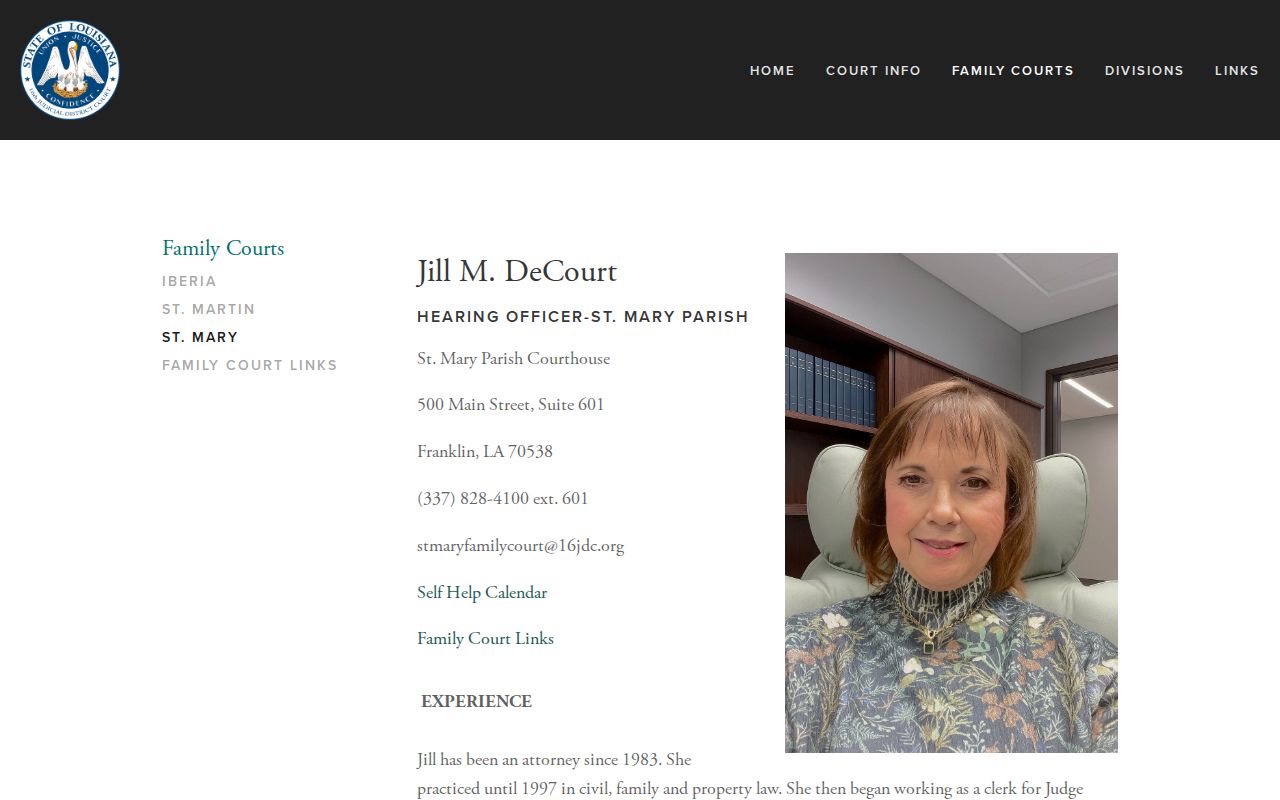
Treat the link as a doorway, not an answer. Pair it with the case record and a call to the division office to nail down the operative St. Mary Parish court date.
Finding Your Court Date
Begin with the most specific paper you have. A citation, summons, written notice, or the last line of docket history names the court, the case number, and the type of setting. For a 16th JDC matter, the clerk's St. Mary ESearch is the local route to released index and history information once you have account access. LCRAA is a statewide remote-access layer for participating clerk records, not a public St. Mary civil or criminal calendar. When in doubt, ask. The clerk counter, a division office, and your attorney remain the best channels. Use them to confirm a court date.
- Read the court name on the citation, summons, or latest court notice. A City Court of Morgan City or mayor’s court setting is not automatically a 16th JDC setting.
- Write down the exact case or citation number, party name, filing year, court type, and division if one is printed. Search the exact number before using a broad name search.
- For a district case, check the released St. Mary ESearch docket history and the official 16th JDC calendar route. A new matter may not yet be indexed or released.
- If the online calendar requires sign-in or does not show the case, call the division or the 16th JDC St. Mary main line at (337) 828-4100. The St. Mary Parish Clerk counter at 500 Main Street is another record-confirmation route.
- At the courthouse, ask whether a printed docket sheet or the courtroom docket call supplies current notice. No public online posted-docket archive was confirmed, so verify any posting with the court.
- For city and mayor’s court matters, use the citation and that court’s clerk or town contact. A party’s attorney can also confirm a changed setting with the court.
- Ask whether the date is the current operative setting, whether an appearance is in person or remote, and whether a later continuance, reset, or cancellation appears in the record.
ESearch has limits. Some things it will not display. For a document image, certified docket, or filing, ask the St. Mary Parish Clerk of Court for the official record. The difference between released online history and the official record matters. The St. Mary Parish case lookup page explains where each one ends.
St. Mary Parish Division Date Checks
When the calendar shows no current entry, call the division. Division C's St. Mary office answers at (337) 828-4100, extension 620. Division F uses the same main number at extension 6430. The St. Mary family hearing officer sits at extension 601. Division B handles matters across each of the district's three parishes. It lists a St. Martinville number: (337) 394-2216, option 3. Have the full case details ready. An office cannot guess your hearing from a name alone. Division B's official page links a self-service civil calendar. It works through Calendly. The provider view displays the booking fields the court has configured.
A scheduling tool is not a docket. The provider page alone does not establish a fixed public calendar of St. Mary Parish hearings. Confirm the case, time, location, and setting type with the division before you act on any date.
How to Read a Court Setting
A St. Mary Parish court setting is a plan, not a result. It tells you when a hearing is scheduled. It does not say whether it happened or how the case ended. So treat each entry as a court date to confirm. Work through the docket history from the oldest entry to the newest. A later entry can bump an earlier date. The most recent one usually controls. The 16th JDC's public calendar does not show one fixed set of fields on every screen. So the table sticks to what you can check from the notice, the history, the calendar, or the court office itself.
| Date | The scheduled day on the latest notice or released history. Ask whether a later entry supersedes it. |
|---|---|
| Time | The stated appearance time. It may be a docket call or a particular hearing time, so confirm with the court. |
| Courtroom | The room, floor, or court location on the notice. No universal public calendar-room field was captured. |
| Judge or Division | The division or presiding judge identified by the case paperwork; use it to reach the correct office. |
| Setting Type | The event described as arraignment, motion hearing, status conference, trial, family conference, or another listed proceeding. |
St. Mary Parish Setting Terms
St. Mary Parish courts use several common setting types. But no local page publishes a confirmed shorthand-code list. Never treat an unexplained abbreviation as a result. A motion or status conference setting is a request on the schedule, not a judgment. An entry saying a matter was set does not mean it was heard. Read the latest full wording. Then let the division's confirmation settle anything a code leaves unclear.
- Arraignment
- An early criminal appearance addressing charges, rights, or plea procedure. Morgan City publishes Tuesday arraignments.
- Motion hearing
- A scheduled court session for a request that the judge make a ruling before final disposition.
- Status conference
- A proceeding used to assess the case’s progress or identify the next action; it is not itself a trial.
- Continuance or reset
- A move from one setting to another date. The later setting is the practical date to confirm.
- Family hearing-officer conference
- A family-court proceeding that can produce a recommendation, with later district-court action on objections or issues.
Note: A St. Mary Parish court calendar is a scheduling tool. An order or judgment is the filed record that establishes a ruling.
Continuances, Resets, and Cancellations
A hearing date in St. Mary Parish only moves when the court itself approves the change. A continuance, a reset, or a cancellation each calls for a fresh look at the latest setting. Do that before you rely on it. The 16th JDC family-court pages post motion forms for continuing and resetting hearings. Those come in opposed and unopposed versions. That tells you something important. Filing the motion is only a request. The clerk cannot informally edit the date on its own. Keep honoring the original notice until a judge signs off. A new setting must appear on the docket.
Docket history tells the story in order. An older entry that says "set" gives way to a later line. That line may note a continuance, a reset, or a new date. When you call to confirm, spell out the status rather than relying on a local code label. The court does not publish those labels. Holiday closures can shut the counter, but only the court's order decides whether a hearing actually moves. The court maintains no standing public Zoom link or permanent Zoom rule for St. Mary Parish hearings.
St. Mary Parish Court Date Reset Forms
The 16th JDC family court links gather the pieces in one place. You get routes to the current calendar, hearing-officer forms, and the paperwork for continuing or resetting a hearing. The forms show why a setting changes through a formal request plus court action. They do not prove every division works the same way, though. For a contested date in a St. Mary Parish case, follow the procedure the assigned court states. Or get legal advice. The official family-court links page shows the forms and calendar routes in full.
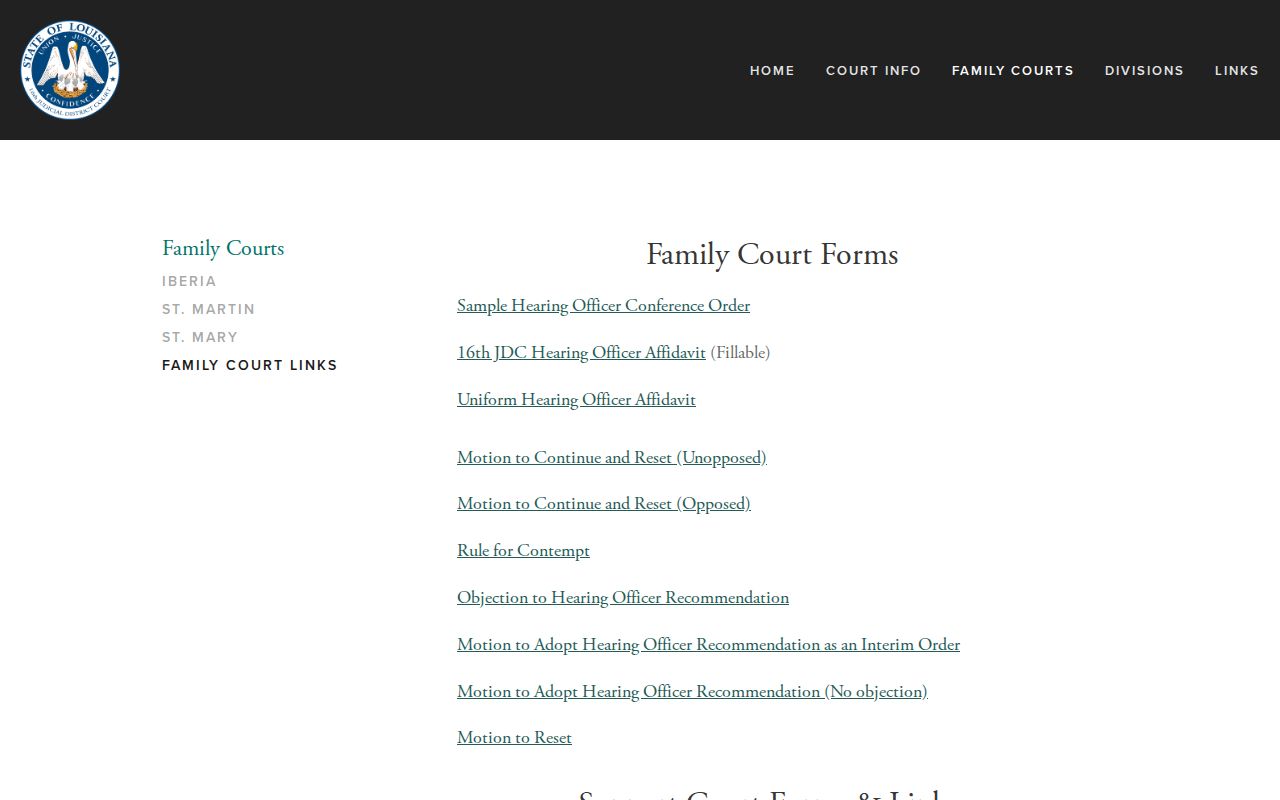
The forms make one thing plain. Before treating an old St. Mary Parish court date as cancelled, check for a later minute entry, an order, or the division's response on the docket.
If You Miss a Court Setting
If you missed a required appearance, act fast. Contact the court or division named on the notice. Explain the missed setting, and ask where the case stands now and what to do next. The clerk of court can confirm what the record shows. But deciding how a missed appearance gets handled belongs to the court alone. One more caution: a Morgan City or other city-court matter runs through that separate court. Do not assume it sits in the St. Mary Parish district docket.
Missed a Setting? Missing a required court setting can lead to a failure-to-appear action, warrant, bond consequence, or other court response depending on the case and court order.
Contact the assigned court, division, or attorney immediately and ask whether a new setting, written motion, or appearance is required.
Speak with a licensed Louisiana attorney about a missed St. Mary Parish setting before relying on an old docket line or appearing without instructions.
St. Mary Parish Jury Date Messages
Jury service has its own confirmation route in St. Mary Parish. The St. Mary Clerk's jury instructions tell jurors to call a recorded message after 6 p.m. the day before service. Jurors then report to the sixth floor as directed. That recording covers jury attendance only. It cannot substitute for a party checking an individual case setting. A civil jury notice naming a date and judge still calls for confirming the proceeding through the docket and the court office.
Morgan City posts recurring dates that help you get oriented. They never replace a direct call. Arraignments run Tuesday at 2 p.m., trials Thursday at 2 p.m., juvenile court Wednesday, and civil or small claims usually Wednesday morning around 9 a.m. For a current Morgan City date, call City Court at (985) 384-2718. Franklin Third Ward City Court takes direct calls at (337) 828-3858. There the citation and the court clerk control the setting.